Case Study · Paid Media · 2024 to 2025
Rebuilding Google Ads from the ground up:
a 6-month growth story.
How I overhauled a stagnant paid media account, restructured every campaign, and drove record-breaking revenue performance for a B2B e-commerce brand in the UK.
01 — Background
The situation when I took over
When I first took ownership of the paid media function at a UK-based B2B e-commerce company specialising in industrial support systems, the Google Ads account had been running on autopilot. Specifically, campaigns were broadly targeted, bid strategies were misaligned with business goals, and there was no structured approach to product segmentation, negative keywords, or audience layering.
In fact, the business had strong foundations: a growing customer base of over 94,000, thousands of five-star reviews, and a product catalogue with real commercial depth. However, the paid media simply was not reflecting any of that potential. As a result, my brief was clear: take full ownership, rebuild strategically, and make every pound of ad spend work considerably harder.
02 — Challenges
What I was working against
|
No campaign segmentation
All products were grouped into broad campaigns with no category separation, making performance analysis and budget allocation nearly impossible. |
Wasted spend on irrelevant queries
The negative keyword list was minimal and outdated. Consequently, a large portion of budget was consumed by non-converting search terms with zero commercial intent. |
|
Bing completely underutilised
Microsoft Advertising was active in name only. It had never been properly configured for the B2B audience that uses Bing professionally in trade and engineering sectors. |
No remarketing or audience strategy
There was zero structured remarketing in place. Website visitors were not being re-engaged, and furthermore, no audience signals were feeding into Smart Bidding algorithms. |
03 — What I Did
Six months of structured change
A month-by-month breakdown of every change made across the account
First, I ran a complete audit of every live campaign, ad group, and keyword in the account. Following this, I rebuilt the entire campaign structure from scratch. I separated the top product categories into dedicated campaigns, each with its own budget and a bid strategy matched to the margin profile and conversion intent of that category.
Next, I built a proper negative keyword framework, blocking irrelevant queries at both campaign and account level. In addition, I introduced weekly search term reviews to catch wasteful spend early. This freed up budget to move toward high-intent terms that were actually converting.
Following this, I launched Google Shopping campaigns with a full product feed optimisation through Google Merchant Center. This included accurate titles, descriptions, and custom labels for proper segmentation. Furthermore, I introduced Performance Max campaigns for the highest-volume categories, supplying them with audience signals and ad creatives to grow reach without sacrificing ROAS targets.
Additionally, I rebuilt the Bing Ads account from scratch. I used LinkedIn Profile Targeting, which is exclusive to Microsoft Advertising, to reach decision-makers by job title, industry, and company size across construction, manufacturing, and engineering sectors. As a result, this channel ended up delivering a lower CPC than Google with a noticeably higher conversion rate from B2B buyers.
Furthermore, I set up dynamic remarketing across Google Display and Meta Ads, targeting users who had browsed products but not completed a purchase. I also launched Meta Advantage+ Catalogue campaigns alongside cold prospecting ad sets. Moreover, A/B testing on ad copy, creatives, and landing pages was introduced across all channels at the same time.
Finally, I moved the top-performing campaigns across to Target ROAS smart bidding once there was enough conversion data to support it. I also built a GA4 and Google Ads reporting dashboard to track ROAS, CPA, and conversion rate at category level. As a result, the business had full cross-channel performance visibility for the first time.
04 — Results
The numbers after 6 months
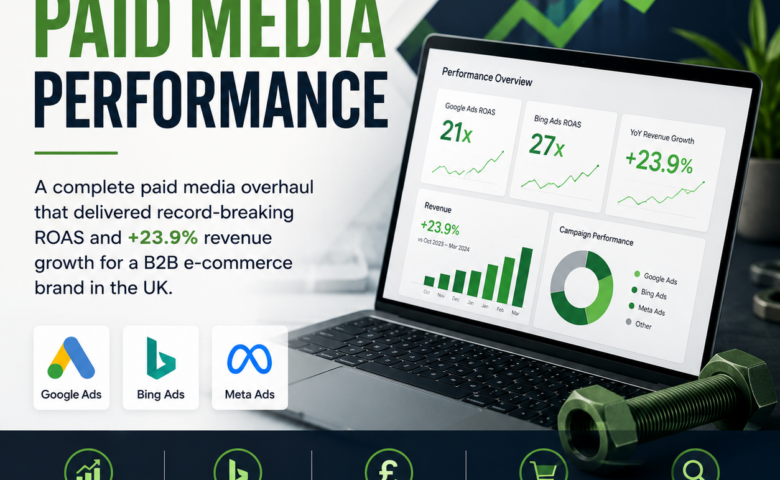
By the end of the six-month period, the account had been completely transformed. In addition, every channel was performing above industry benchmarks. Consequently, the business recorded its strongest year-on-year revenue growth in recent history, driven in large part by the restructured paid media strategy.
|
21x
Overall Google Ads ROAS, up from a poorly structured baseline
|
34x
Top-performing category ROAS (Stainless Steel range)
|
27x
Bing Ads ROAS, outperforming Google at £0.48 avg. CPC
|
|
+23.9%
Year-on-year total website revenue growth
|
+26%
Organic search impressions growth from parallel SEO activity
|
+2.5%
Organic click growth with improved average ranking position
|
“The restructure did not just improve ROAS. It gave full visibility into which product ranges were generating the best return, which made future investment decisions a lot easier to justify.”
05 — Key Learnings
What actually made the difference
- 01.First and foremost, campaign architecture matters more than most people realise in B2B e-commerce. Separating product categories into distinct campaigns with individual budgets makes performance transparent and budget decisions much easier to defend.
- 02.In addition, Bing Ads is seriously underestimated for B2B. LinkedIn Profile Targeting on Microsoft Advertising consistently delivered higher-intent traffic at a lower CPC than Google. For industrial and trade brands, it is a significant untapped advantage.
- 03.Furthermore, Smart Bidding only works properly once the account has enough conversion data behind it. Switching to Target ROAS too early will actively hurt performance. As a result, those first two months of manual bidding were not wasted time — they were essential groundwork.
- 04.Similarly, negative keyword management is not something you do once and forget. Weekly search term reviews were consistently one of the highest-return activities across the full six months.
- 05.Finally, cross-channel attribution is what gives you the full picture. Paid search, remarketing, and organic were all contributing. Consequently, looking at any one channel in isolation would have led to completely the wrong conclusions about what was actually driving revenue.
06 — Tools & Platforms
Tech stack used
Google Merchant Center
Google Analytics 4
Google Search Console
Microsoft Advertising (Bing)
Meta Ads Manager
SEMrush
Screaming Frog
WooCommerce
Performance Max
LinkedIn Profile Targeting
Interested in working together?
I am available for paid media consultancy, Google Ads audits, and multi-channel marketing projects across the UK.
Leave a Reply